


Agentic threat intelligence is an emerging CTI model where bounded agents support repetitive investigation work, such as collection, enrichment, prioritization, and evidence packaging, while analysts retain control over takedown and escalation decisions.
Vendor briefings are full of “agentic AI” right now. Most of them describe the same thing: faster dashboards and smarter alerts. That is not agentic threat intelligence.
In practice, agentic CTI means agents can execute multi-step workflows within defined boundaries: detecting suspicious infrastructure, enriching findings, scoring risk, and packaging evidence for analyst review without a human directing each step. It does not mean autonomous enforcement. Analysts still own consequential decisions. The agent does the legwork; the analyst makes the call.
This article cuts through the noise. You’ll get a clear definition, a practical view of where agentic CTI is likely to matter first, and a framework for separating credible workflow evolution from AI-washed security claims.
The Intelligence Isn’t the Problem. The Delivery Model Is.
Most CTI teams aren’t drowning in bad intelligence. They’re drowning in good intelligence they can’t act on fast enough.
APWG recorded over 3.8 million phishing attacks across 2025, with Q2 alone hitting 1.13 million, the highest quarterly total in two years. Each one represents a potential brand impersonation, a fraudulent domain, or a scam page targeting your customers right now.
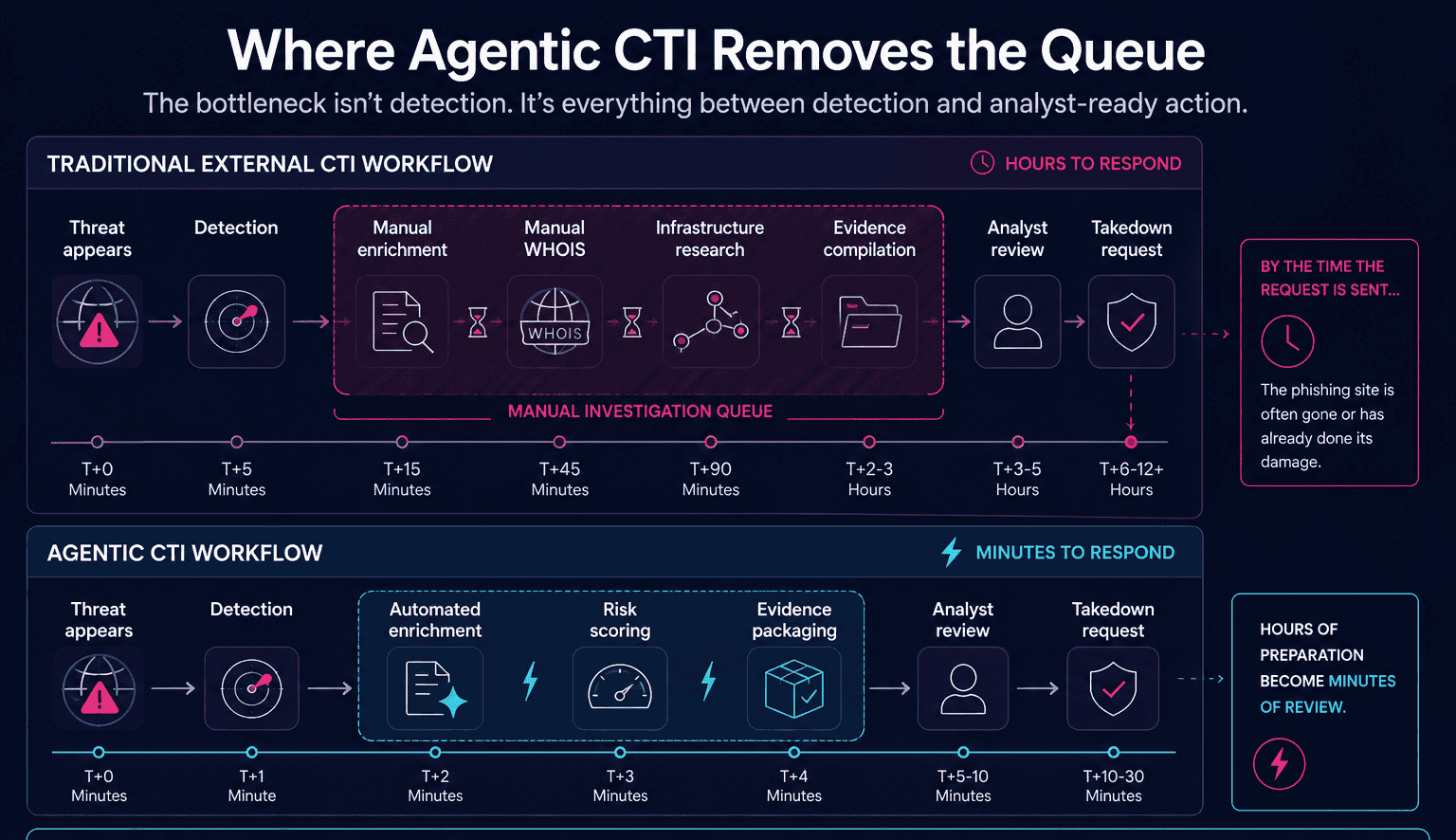
The average phishing site lives just 54 hours, with a median under six hours. In most external CTI workflows, that window gets consumed entirely by the manual process: threat detection queued, analyst assigned, investigation started, takedown initiated. By the time the ticket closes, the attack has already done its damage.
This isn’t a failure of intelligence quality. The feeds are rich. The signals are there. The failure is operational: manual investigation queues, analyst-dependent triage, and service-delivery pipelines that weren’t built for today’s threat volume.
Detection loses value when evidence preparation, routing, and escalation cannot move at the same speed as the threat. The gap is not visibility alone. It is the operational distance between detection and analyst-ready action.
AI-powered threat intelligence is a structural fix to that gap. Not a replacement for analysts. Not a sci-fi promise of autonomous remediation. It’s a delivery model redesign, where an agent handles enrichment, prioritization, evidence packaging, and escalation routing so analysts can focus on what only humans should do: exercise judgment, authorize enforcement, and own decisions that carry legal, reputational, or customer-experience weight.
The intelligence was never the bottleneck. The workflow was. Agentic CTI is how external threat teams close that gap without scaling headcount to match threat volume.
Why Traditional External CTI Struggles to Keep Up
Traditional cyber threat intelligence isn’t broken. The data it produces, domain registration patterns, infrastructure relationships, phishing kit fingerprints, is genuinely valuable. The problem is what happens after the intelligence arrives.
The delivery and operationalization model hasn’t kept pace with modern external threats. That gap is getting expensive.
- The scale problem is blunt. Group-IB’s 2025 High-Tech Crime Trends Report identified over 80,000 phishing websites in 2024 alone, a 22% year-over-year increase. That’s roughly 220 new phishing sites every day. When hundreds of suspicious domains are flagged each week, analysts spend hours separating active brand impersonation from benign lookalikes. Without automated enrichment, prioritization becomes a bottleneck before any action is even possible.
- Takedown queues back up fast. Each takedown request requires manual evidence packaging, routing to the right registrar or hosting provider, and follow-up chasing. The BlackBerry Global Threat Intelligence Report puts the average phishing site lifespan at under 12 hours. By the time an analyst assembles the evidence package, the site may already be down, or it’s still live and harvesting credentials while the request sits in a queue.
- The detection-to-action gap is structural. Cybersecurity Insiders’ 2025 Pulse of the AI SOC Report found that 76% of SOCs cite alert fatigue as a top operational challenge. A Tier 1 analyst performing manual triage on an unfamiliar alert type takes 10-20 minutes per case. When volume spikes, analysts don’t investigate more carefully. They start clearing queues by dismissing low-fidelity alerts without adequate review. Real threats get buried in the noise.
- Service-heavy delivery models add latency by design. Legacy CTI delivery depends on vendor-side analysts producing reports, writing up findings, and routing them through service queues. That model made sense when threats persisted for days or weeks. It doesn’t work when a phishing site targeting your brand can appear, harvest credentials, and disappear in less time than it takes to file a support ticket.
This isn’t a talent problem. The best analysts in the world can’t manually investigate 80,000+ phishing sites per year at the speed those sites operate. No amount of hiring closes that gap.
The constraint isn’t intelligence quality. It’s workflow architecture, and that’s exactly what needs to change.
The Scale Problem Is Structural, Not Solvable by Hiring
Here’s the math that breaks every headcount argument: Microsoft Threat Intelligence detected approximately 8.3 billion email-based phishing threats in Q1 2026 alone. One quarter. No team can triage that volume manually, regardless of budget.
The threat surface isn’t just email. Brand impersonation domains, fake social profiles, fraudulent mobile apps, and scam ads compound the problem across every external channel. Each one requires detection, investigation, enrichment, and a prioritization decision before an analyst can act.
Hiring more analysts doesn’t fix this. The ISC2 2024 Cybersecurity Workforce Study put the global cybersecurity workforce gap at 4.8 million unfilled positions. The talent pool isn’t growing fast enough to absorb the workload, and even if it were, the economics don’t hold.
The real constraint isn’t analyst skill. It’s analyst time. Every hour spent on manual enrichment, deduplication, and evidence gathering is an hour not spent on judgment, escalation, and enforcement decisions.
The answer isn’t a bigger team. It’s a different architecture for how intelligence gets collected, enriched, and routed before it ever reaches an analyst’s queue.
What ‘Agentic’ Actually Means in Threat Intelligence
Most ‘AI-powered’ CTI claims aren’t agentic. They’re automated. The difference matters more than most vendors want to admit.
As Cyware President Jawahar Sivasankaran put it in a February 2026 article: “Much of what is labeled ‘AI-powered’ today is simply repackaged functionality.” A Cyware survey backs this up: 78% of security teams believe AI can improve threat intelligence, but only 43% report meaningful operational impact. The gap between belief and reality is where AI-washing lives.
- Automation vs. agentic: a real distinction
Traditional automation executes a single, predefined action when a condition is met. A script fires when a domain matches a blocklist pattern. A static playbook routes an alert to a queue. Rule-based systems do exactly one thing, exactly when told. They don’t plan, adapt, or sequence tasks based on what they find along the way.
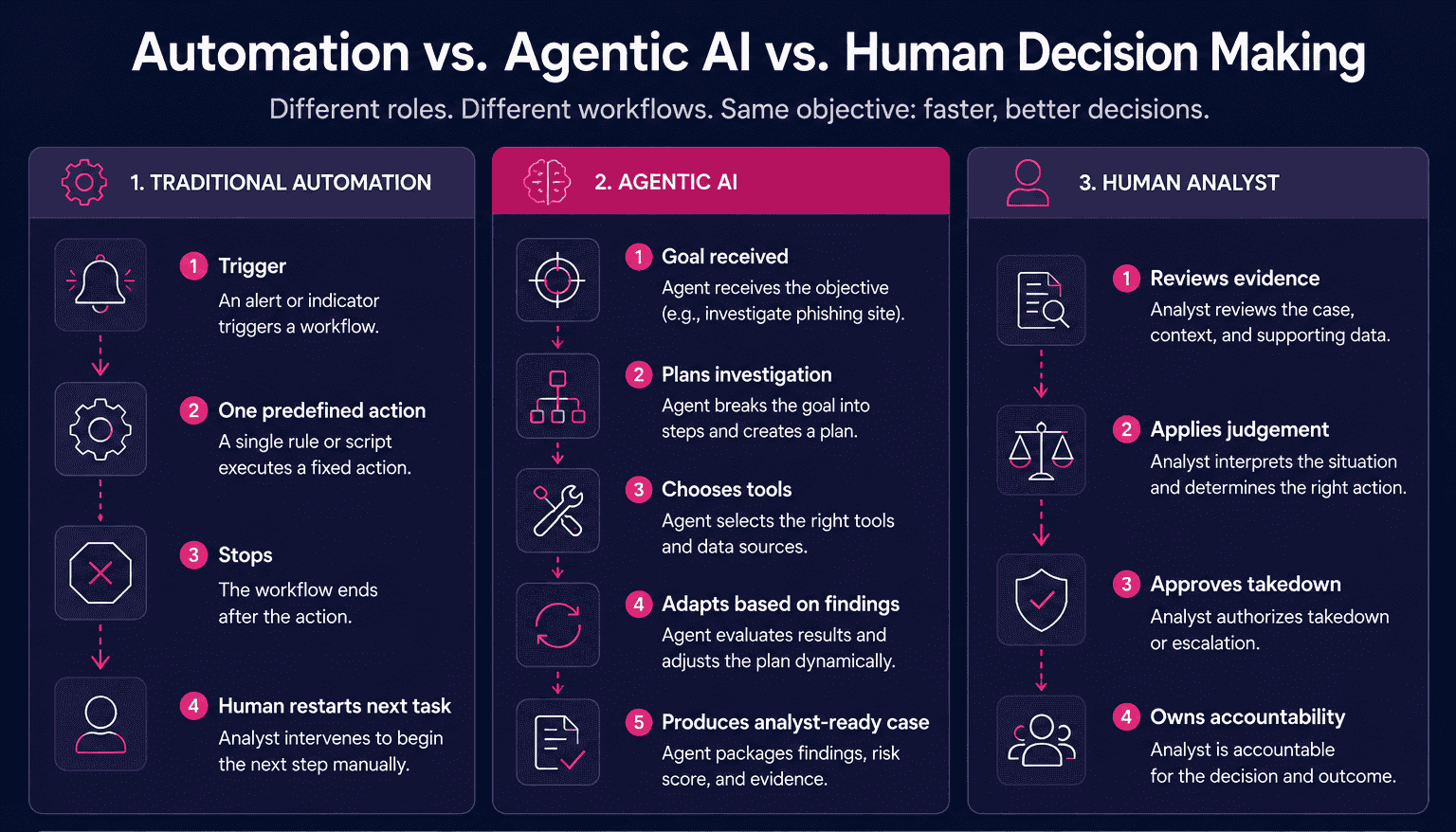
Agentic AI is structurally different. An agentic system can:
- Plan a multi-step investigation toward a defined goal
- Select and use tools autonomously, such as WHOIS lookups, certificate transparency logs, domain registrar APIs, and visual similarity engines
- Execute conditional logic without a human directing each step
- Adapt based on intermediate findings, changing course if early results shift the risk picture
- Operate across multiple data sources in sequence, not in isolation
The contrast in practice is stark. A rule-based system flags a suspicious domain. An agentic system investigating that same domain queries WHOIS registration data, checks certificate transparency logs, pulls infrastructure relationships, runs visual similarity analysis against the brand’s legitimate site, cross-references known phishing infrastructure, scores the risk, and packages the evidence. All without a human directing each step.
| Traditional Automation | Agentic AI | |
| Task scope | Single, predefined action | Multi-step, goal-directed sequence |
| Logic | Rule-based triggers | Conditional, adaptive reasoning |
| Tool use | Fixed integrations | Dynamic tool selection |
| Human input required | At each step | At decision points and high-impact actions |
| Handles new findings | No | Yes, adapts mid-workflow |
- Agentic does not mean unchecked
This is where the hype usually goes wrong. Agentic doesn’t mean autonomous in the reckless sense. Credible agentic CTI implementations are bounded by policy, workflow design, and human oversight for high-impact decisions.
Think of it this way: an agentic system is a highly capable investigator who works independently within a defined brief. It doesn’t go rogue. It doesn’t make enforcement calls. It prepares the evidence, scores the risk, and hands the case to the analyst who owns the decision.
In external CTI workflows, where a wrong takedown call can trigger legal exposure or damage a customer relationship, that boundary isn’t a weakness. It’s the whole point.
Agentic Is Not the Same as Autonomous
The misconception that derails most conversations about agentic CTI: agentic does not mean unsupervised.
An agentic system can plan, sequence tasks, and operate across multiple data sources without step-by-step human instruction. That’s not the same as acting without accountability. As CrowdStrike CTO Elia Zaitsev noted in Dark Reading, every credible agentic security deployment introduces autonomy in stages, with human control designed into the system from the start, not bolted on afterward.
For CISOs and fraud prevention leaders, this distinction isn’t academic. Takedown decisions, customer-impacting escalations, and enforcement actions carry legal, reputational, and operational weight. A wrong call isn’t just a technical error. It’s a liability.
The model is straightforward: the agent does the legwork. The analyst makes the call.
Agents operate within defined workflow boundaries. They collect, enrich, score, and package. They don’t authorize enforcement. That authority stays with the human who understands the full context and owns the outcome.
This isn’t a limitation of agentic CTI. It’s the design.
How Agentic Threat Intelligence Workflows Work in Practice
Here’s a question worth sitting with: if a cluster of phishing domains targeting your brand went live at 2 a.m. on a Friday, how long before an analyst sees them?
For most teams, the honest answer is: too long. APWG recorded over one million phishing attacks in Q1 2025 alone, with financial services and online payments accounting for nearly 31% of all targets. The volume isn’t slowing down. The analyst queue is.
Agentic CTI changes the shape of that problem. Here’s what the workflow actually looks like for a realistic external threat scenario.
- The scenario: A mid-size retail bank is being impersonated across a wave of newly registered domains, and a fake mobile banking app has appeared in a third-party app store.
- Step 1: Continuous monitoring
The agent monitors external threat sources around the clock without waiting for a human to kick off a search. Domain registration feeds, certificate transparency logs, app store listings, social media platforms, and web crawl data are all in scope. No shift handover. No ticket to open.
- Step 2: Detection
The agent identifies a cluster of newly registered domains with lexical and visual similarity to the bank’s legitimate domain. It also flags the suspicious app listing. Neither finding required a human to notice something looked off.
- Step 3: Enrichment
This is where the heavy lifting happens. Without waiting for analyst instruction, the agent queries WHOIS registration data, maps hosting infrastructure relationships, pulls SSL certificate details, runs visual similarity analysis against the bank’s brand assets, and cross-references known phishing infrastructure patterns. What would take an analyst 45 minutes per case gets done in parallel across every flagged finding.
- Step 4: Scoring and prioritization
Not every lookalike domain is a live threat. The agent scores each finding by risk level and confidence, separating high-priority active impersonation from lower-risk registrations that may be defensive or benign. Analysts see the cases that need them, not a raw feed of everything.
- Step 5: Evidence packaging
For high-priority cases, the agent compiles a structured case file: domain registration details, infrastructure relationships, visual impersonation evidence, victim exposure indicators, and recommended action paths. The analyst opens a case that’s already built, not a blank page.
- Step 6: Escalation routing
The packaged case routes to the appropriate analyst queue with full context attached. Under predefined, human-approved policies, the agent can also initiate a takedown workflow for analyst review and authorization.
The agent never makes an enforcement decision. It doesn’t autonomously take down a domain, remove an app listing, or contact a registrar. Every enforcement action requires analyst authorization.
The agent does the groundwork. The analyst makes the call.
That distinction matters more than it might seem. Phishing sites have a short window of peak harm, with research showing median lifespans under two hours for detected sites. Speed to analyst-ready evidence is where agentic CTI earns its value, not by cutting the analyst out of the loop.
Watch: What to Look for in a Phishing Detection and Takedown Workflow
This discussion adds useful context for evaluating phishing detection and takedown workflows, especially where manual evidence gathering, prioritization and analyst review create delays.
Why Human-Supervised Agentic CTI Is a Feature, Not a Fallback
Here’s a claim that cuts against the AI hype cycle: the most credible agentic CTI deployments are the ones that keep humans in the loop. Not because the technology isn’t capable enough. Because the decisions are too consequential to get wrong.
External threat workflows carry real stakes. A takedown request filed against the wrong domain doesn’t just fail to stop a phishing campaign. It can disrupt legitimate customer access, damage partner relationships, or create legal exposure. Brand impersonation cases often sit in grey zones: a domain that looks suspicious might belong to a reseller, a regional affiliate, or a legitimate third party using similar branding. Premature enforcement isn’t a minor error. It’s a customer-experience incident and potentially a legal one.
These are not decisions to delegate to an agent operating without human review, regardless of how well-trained the model is.
- The division of labor that actually works
The right architecture isn’t agent-does-everything or analyst-does-everything. It’s a clean split: the agent handles the groundwork, the analyst makes the call.
The agent collects across external threat sources, enriches domain and infrastructure data, deduplicates findings, scores risk, and prepares a complete evidence package. By the time an analyst sees a case, the investigation is largely done. The analyst reviews the evidence, applies judgment, and authorizes enforcement. That’s not a limitation on the agent. That’s the agent doing exactly what it should.
As ISACA Journal guidance from 2025 frames it: “automate the routine, escalate the consequential.” That principle maps precisely to external CTI. Collection, enrichment, and prioritization are routine. Takedown authorization is consequential.
- Why this model is easier to deploy and defend
For CISOs and fraud prevention leaders who’ve been burned by overhyped AI claims, human-supervised agentic CTI has a practical advantage beyond accuracy: it’s auditable, justifiable, and easier to get approved.
Legal and compliance teams can review the decision trail. Executive stakeholders can see where human judgment was applied. When an edge case surfaces that the agent can’t handle reliably, the analyst is already in the workflow to catch it.
According to a Cyber Security Tribe survey of 455 cybersecurity practitioners conducted in late 2025 and early 2026, 73% of organizations are already using or developing agentic AI in security. That points to a practical deployment pattern: agentic security adoption is most defensible where autonomy is bounded, auditable, and paired with explicit human oversight for high-impact decisions.
- The credibility argument
Fully autonomous enforcement sounds efficient in a vendor pitch. In practice, it introduces liability, reduces auditability, and fails unpredictably on the cases that matter most.
Human-supervised agentic CTI doesn’t ask analysts to trust the agent blindly. It asks them to review faster, decide with better context, and authorize action with confidence. The agent compresses hours of investigation into minutes. The analyst brings the judgment no model can reliably replicate.
That’s not a fallback. That’s the architecture.
What Agentic Threat Intelligence Can and Can’t Do Today
The credible near-term use cases for agentic CTI are bounded, repetitive, and human-supervised. The strongest applications are not the ones that promise full autonomy. They are the ones that reduce manual investigation work while preserving analyst control over consequential decisions.
What agentic CTI can do today
- Continuous collection across external threat sources: domain registration feeds, certificate transparency logs, app stores, social platforms, and web crawl data, without waiting on an analyst to kick off a query
- Automated enrichment of domain and infrastructure data, pulling registration history, hosting relationships, and visual impersonation evidence without human initiation
- Deduplication and noise reduction across high-volume external threat feeds, so analysts aren’t reviewing the same suspicious domain three times from three different sources
- Risk scoring and prioritization of brand impersonation and phishing findings, ranked by confidence and potential impact
- Evidence packaging: structured case files with registration data, infrastructure relationships, and screenshot-based visual impersonation evidence, ready for analyst review
- Escalation routing to the right analyst queue with full context already attached
- Takedown workflow initiation under predefined, human-approved policies. Not autonomous enforcement, but structured preparation that removes the manual setup work
- Significant compression of investigation time. The practical value of agentic CTI is reducing the manual groundwork analysts must complete before they can review, escalate, or authorize action. The category should be judged by how effectively it shortens the path from external signal to analyst-ready evidence, not by how loudly it promises autonomy.
What agentic CTI cannot do today
- Fully replace CTI analysts. Edge cases, novel threat patterns, and ambiguous infrastructure relationships still require human judgment. Agents are good at pattern execution; analysts are good at pattern recognition in unfamiliar territory
- Autonomously resolve all threat types. Some findings don’t fit clean scoring models. Agents can flag them; analysts must interpret them
- Make unsupervised enforcement decisions. Takedowns, legal escalations, and customer notifications require analyst authorization. Full stop
- Handle every contextual nuance. Legal jurisdiction, brand-specific context, and the downstream consequences of a false takedown are not problems an agent can weigh without human input
- Guarantee zero false positives. Agents score and prioritize with high accuracy, but analysts must validate before any enforcement action is taken
As Forrester notes, use-case-specific and domain-specific task agents must come before attempting to solve broader, end-to-end automation problems. The same logic applies here.
The honest summary: agentic CTI today is a force multiplier for analyst capacity, not a replacement for it. Any vendor claiming their system handles all of the above without human oversight is either overstating current capability, or describing a system you should not want running unsupervised on your brand’s behalf.
Why External Threats Are the Right Starting Point for Agentic CTI
Not all CTI workflows are equally ready for agentic AI. Internal incident response, vulnerability management, endpoint telemetry analysis: these are valid future territory, but they’re messy starting points. The data is sensitive, the context is organizational, and the judgment calls are high-stakes in ways that make autonomous agent action genuinely risky.
External digital threats are different. They’re structurally built for this.
- 1. The volume is relentless, and the workflow pattern is consistent
APWG tracked 3.8 million phishing attacks across 2025. That’s not a spike. It’s a baseline. Brand impersonation, scam sites, fake social profiles, fraudulent app listings, suspicious domain registrations: these threats generate thousands of investigation tasks per month for any mid-to-large enterprise in financial services, eCommerce, or telco.
The operational pattern is consistent: every one of those tasks follows the same basic workflow. Detect a potential threat. Enrich it with domain registration data, hosting infrastructure, and visual evidence. Score it by risk and confidence. Package the findings. Route it for analyst review or takedown action.
Detect, enrich, prioritize, package, route. That’s the workflow. It repeats thousands of times. Agents execute repetitive, well-defined workflows reliably, and this one is about as well-defined as it gets.
- 2. The data sources are external and openly accessible
Investigating a suspicious domain doesn’t require access to internal systems, employee records, or sensitive organizational data. The evidence lives outside: WHOIS registration records, certificate transparency logs, hosting infrastructure relationships, visual content, app store listings, social platform data.
These sources are accessible via APIs and web crawl, and don’t carry the organizational sensitivity that makes internal telemetry complex to work with. An agent can query them continuously, across thousands of targets simultaneously, without the access friction or data governance concerns that come with internal security tooling.
- 3. The task boundaries are clear
In internal incident response, the agent needs to understand endpoint behavior in context, correlate user activity against organizational norms, and make judgment calls that depend on knowing who the user is and what normal looks like for that environment. That’s a lot of implicit context.
External CTI tasks don’t carry that weight. The agent knows what it’s looking for: a domain that visually impersonates a brand, infrastructure that overlaps with known phishing campaigns, a social profile using stolen brand assets. The inputs are defined. The outputs are defined. The agent can execute without needing to understand organizational politics or internal asset criticality.
Internal incident response and vulnerability management will get there. Internal incident response and vulnerability management may develop in this direction over time .But they’re harder starting points: more contextual complexity, more organizational sensitivity, more risk in getting it wrong.
External CTI is where the structural fit is strongest today. The volume justifies automation. The data is accessible. The workflow is repeatable. That’s why external digital threats are the natural first domain for agentic CTI to prove its value.
The Near-Term Opportunity: From Detection to Response Without the Queue
The gap that matters most in external threat workflows isn’t between detection and takedown. It’s between detection and an analyst being ready to act.
APWG tracked 3.8 million phishing attacks across 2025. The average phishing site lasts under 12 hours before takedown. Yet the manual enrichment work sitting between a detected threat and an analyst-ready case can consume hours on its own. That is the queue agentic CTI is designed to reduce.
For teams managing brand impersonation and phishing infrastructure at scale, the near-term opportunity breaks down into four practical areas:
- Removing manual enrichment groundwork. The hours analysts currently spend pulling domain registration data, mapping infrastructure relationships, and assembling visual impersonation evidence can be handled by agents working continuously in the background. The analyst arrives at a prepared case, not a raw signal.
- Improving prioritization accuracy. Agents that continuously enrich and score findings help security and fraud teams direct attention toward the highest-risk, highest-confidence threats first, rather than working through undifferentiated queues where a critical case sits behind a dozen low-priority ones.
- Accelerating evidence packaging for takedowns. Takedown workflows that currently require analysts to manually compile registration data, hosting relationships, and screenshot evidence move significantly faster when agents handle that preparation step. The analyst reviews and authorizes. They don’t build the file from scratch.
- Compressing detection-to-response time. For financial services, eCommerce, airlines, hospitality, and telco brands facing high volumes of external impersonation, the practical win is narrowing the window between a threat appearing and an analyst being ready to act.
The teams that will benefit most are those with high-volume external threat workloads where the investigation pattern is consistent enough for agents to execute reliably. Brand impersonation, phishing infrastructure, and suspicious domain monitoring fit that description precisely.
This is where external threat intelligence workflows are heading: not toward unchecked autonomous remediation, but toward faster, evidence-led workflows where repetitive investigation steps are increasingly automated and consequential decisions stay with human analysts.
Conclusion: External Threat Intelligence Is Moving Toward Faster, Evidence-Led Workflows
Agentic threat intelligence solves a specific, structural problem: the manual enrichment queue that sits between a detected threat and an analyst ready to act. It won’t replace CTI analysts, and it won’t autonomously remediate threats. Its near-term value is more specific: compressing triage time, reducing investigative groundwork, and helping external threat teams move from discovery to analyst-ready evidence before phishing infrastructure disappears or causes further harm.
Memcyco’s platform is built for the external threat workflows this article describes – continuous monitoring, enrichment, evidence packaging, and human-supervised takedown initiation for brand impersonation and phishing infrastructure. Schedule your Memcyco product tour here.
FAQs
What is agentic threat intelligence?
Agentic threat intelligence refers to CTI workflows where AI agents autonomously execute multi-step tasks – collecting data from external threat sources, enriching findings with domain and infrastructure data, scoring and prioritizing risks, and packaging evidence for analyst review – without requiring step-by-step human instruction. Unlike simple automation, agentic systems can plan, use tools, handle conditional logic, and adapt based on intermediate results. Critically, agentic CTI does not mean autonomous enforcement: human analysts retain control over consequential decisions like takedowns and escalations.
How is agentic threat intelligence different from traditional automation?
Traditional automation executes a single predefined action when a specific condition is met – a script fires, a playbook runs, a rule triggers. Agentic AI can sequence multiple tasks, select the right tools for each step, handle conditional logic, and adapt based on what it finds along the way. For external CTI, this means an agent can detect a suspicious domain, query WHOIS data, check infrastructure relationships, run visual similarity analysis, score the risk, and package the evidence – all in a single autonomous workflow, without a human directing each step.
Can agentic threat intelligence replace CTI analysts?
No – and any vendor claiming otherwise is overstating current capability. Agentic CTI is designed to eliminate the manual groundwork that slows analysts down, not to replace analyst judgment. Edge cases, novel threat patterns, ambiguous findings, and high-stakes enforcement decisions – like takedowns, legal escalations, and customer notifications – still require human expertise and authorization. The right framing is: the agent does the legwork, the analyst makes the call.
Why are external threats like brand impersonation and phishing a better fit for agentic CTI than internal security use cases?
External threat workflows have three structural characteristics that make them well-suited to agentic CTI: high volume and repetitive investigation patterns (detect, enrich, prioritize, package, route), external and accessible data sources (WHOIS, certificate transparency logs, hosting infrastructure, app stores), and well-defined task boundaries with clear inputs and outputs. Internal incident response involves more contextual complexity, organizational sensitivity, and access constraints that make autonomous agent action significantly harder to implement reliably.
What should CISOs look for when evaluating agentic threat intelligence platforms?
Look beyond feature claims to operational evidence. Ask vendors for documented ROI from existing deployments: analyst hours saved per week, reduction in mean time to triage, and percentage of external threat investigations handled without manual enrichment. Ask whether AI agents are embedded in core workflows or bolted on as a separate layer. Ask how the vendor separates current capabilities from future roadmap claims, and how human oversight is enforced for consequential actions. And critically, ask how the platform handles human oversight for consequential decisions – any credible agentic CTI platform should have clear human-in-the-loop controls for takedown initiation and enforcement actions.
How does agentic CTI help with phishing takedown workflows?
In a phishing takedown workflow, an agentic system can continuously monitor external threat sources for new phishing infrastructure, automatically enrich findings with domain registration data, hosting relationships, and visual impersonation evidence, score and prioritize cases by risk and confidence, and package a complete evidence file for analyst review – all before a human analyst touches the case. Under predefined, human-approved policies, agents can also initiate takedown workflows, routing the packaged case to the appropriate registrar or hosting provider contact. The analyst reviews, authorizes, and owns the enforcement decision.

Julian Agudelo is Head of Content, a cybersecurity writer at heart, and his focus at Memcyco covers phishing attacks, digital impersonation, and account takeover fraud. His work translates complex threat intelligence into practical insights for security and fraud leaders. Julian focuses on the tactics used in modern impersonation campaigns and how organizations can better protect customers and digital channels from evolving online fraud threats.


